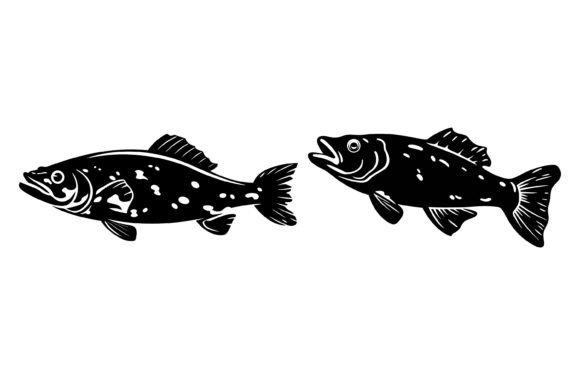
Unleashing the Codfish Vector Illustration for Your Creative Projects
Visual Appeal and Design Characteristics
When you first encounter the Codfish Vector Illustration, you immediately notice its clean, defined lines and a sense of movement that feels both organic and structured. This isn't just a generic clip-art fish; it is a carefully crafted silhouette that balances detail with simplicity. The illustration captures the distinct profile of a codfish—the elongated body, the textured dorsal fins, and the forked tail—with a modern artistic flair. It strikes a chord between realism and graphic design utility, making it versatile enough for serious scientific applications yet stylized enough for creative branding.
The "personality" of this asset leans heavily toward being bold and recognizable. Because it is designed as a vector, the lines remain crisp whether you scale it up for a billboard or shrink it down for a mobile app icon. It carries a professional weight that standard raster images often lack. The silhouette style is particularly effective here; it strips away unnecessary noise, focusing the viewer’s eye on the fundamental shape of the fish. This makes the Codfish Vector Illustration incredibly useful for projects where clarity is paramount. It feels grounded and reliable, much like the sturdy fish it represents, yet it offers enough artistic expression to stand out in a crowded visual landscape.
Practical Applications Across Industries
One of the strongest aspects of this asset is its sheer versatility regarding file formats. The inclusion of both EPS and JPEG formats inside the zip file covers nearly every possible workflow. For designers working in Adobe Illustrator, Affinity Designer, or CorelDRAW, the EPS file is the gold standard. It allows you to deconstruct the illustration, change colors to match specific brand palettes, and scale the graphic infinitely without losing quality. This is essential for logo design and large-format printing where pixelation is unacceptable.
Meanwhile, the JPEG format is ready to go for digital use. If you are a content creator or a social media manager needing a quick visual for a blog post about marine life or sustainable fishing, the JPEG is perfect. It integrates seamlessly into presentations, website headers, and social media graphics. Small business owners in the seafood industry will find this particularly valuable. Imagine using this illustration on a restaurant menu, a "Catch of the Day" chalkboard sign, or packaging for fresh fish products. The Codfish Vector Illustration adapts easily to these contexts because its silhouette is universally understood.
For educators and publishers, this asset serves as an excellent visual aid. In an editorial context, such as a magazine article about oceanography or a textbook on marine biology, the illustration provides a clean, professional look that enhances the reader's experience without distracting from the text. It works well as a chapter opener or a sidebar graphic. Even for personal projects—perhaps a custom t-shirt for a fishing trip or a stencil for a craft project—the high resolution and clean lines ensure a polished result.
Integrating the Illustration into Your Brand Identity
Using a specific graphic asset repeatedly helps build brand identity, and this codfish illustration is strong enough to anchor a visual system. For a brand that wants to convey freshness, reliability, or a connection to the sea, incorporating this silhouette into the logo or favicon creates instant recognition. However, the key to successful integration is consistency. If you are using the Codfish Vector Illustration on your website, ensure it appears in your email signatures and printed collateral as well.
When thinking about visual hierarchy, consider the weight of the illustration. Because it is a silhouette, it has a solid visual mass. This makes it an excellent anchor for layouts that might otherwise feel unbalanced. For example, in web design, you could use a large, semi-transparent version of the fish in the background of a hero section to add texture without overwhelming the headline text. In packaging design, a small, embossed version in the corner of a box adds a touch of class and professionalism.
It is also worth noting how this asset pairs with typography. Since the illustration is organic and curvaceous, it pairs beautifully with sans serif fonts that have clean, geometric lines. The contrast between the natural shape of the fish and the structured typeface creates a dynamic tension that is pleasing to the eye. Conversely, pairing it with a rustic script font can evoke a vintage, nautical feel suitable for heritage brands or artisanal markets. The "Ready to use" and "Easy to edit" features mean you can experiment with these pairings without spending hours tweaking the vector nodes.
Technical Evaluation and Best Practices
Before finalizing your design, always test how the Codfish Vector Illustration behaves in its specific environment. If you are designing for mobile apps, check the silhouette at the smallest possible size (around 16x16 pixels) to ensure the fins don't turn into a blurry mess. While vectors are infinitely scalable, the perception of detail changes with size. At very small sizes, you might need to simplify the illustration further, perhaps by removing the inner line work if the file allows, or just ensuring the surrounding whitespace is sufficient.
Color is another area to explore. While the default might be black or a specific hue, the vector nature of the EPS file allows you to recolor it instantly. Consider using the illustration in a monotone scheme to match your brand's primary color, or use a gradient to give it a more 3D, realistic look if your style guide permits. For print projects, ensure you convert the colors to CMYK to avoid any surprises when the ink hits the paper. The high-quality vector lines ensure that even a single-color print job will look sharp and intentional.
Finally, regarding commercial usage, always review the licensing. Most assets like this are sold under a license that covers both personal and commercial use, but it is good practice to double-check if you plan to use it in a mass-produced product for resale. The investment in a high-quality asset like this Codfish Vector Illustration is negligible compared to the time it saves and the professional polish it adds to your work. Whether you are a seasoned designer or a small business owner trying to DIY your marketing materials, having a reliable, well-crafted vector in your toolkit is a smart move. It elevates the perceived value of your product and ensures your visual communication is as sharp as the design itself.